10 Symmetry in quantum mechanics
The concept of symmetry is extremely important and useful in pretty much every kind of physics. Symmetries constrain the ways in which our system can exist and evolve; taking them into account can often greatly simplify our calculations (and indeed, they cannot be avoided: even if we solve a problem the “hard way”, the presence of symmetry can reveal itself in the form of unexpected simplicity or patterns occuring in our answers!)
The basic idea of a symmetry is that it is a way that our physical system can be changed while preserving certain features. At the beginning of this course when considering the Stern-Gerlach experiment, we noted that the x,y,z direction labels are somewhat arbitrary; if we put an unpolarized beam of silver atoms through a Stern-Gerlach analyzer oriented in any of these directions (or indeed, any spatial direction at all!), we will get the same outcome: two split beams of equal intensity. This reflects the presence of rotational symmetry in the system.
Of course, you should be familiar with symmetry in other physical systems, so let’s talk about how symmetries show up in quantum mechanics in particular.
10.1 Quantum symmetry and Wigner’s theorem
Using our Hilbert space notation, we can imagine that “changing the system” corresponds to some transformation operator \hat{T} that we can construct. Then suppose that our “physical system” consists of a set of states \ket{\psi} and observables \hat{A} with eigenstates \{\ket{a}\}.
With this setup, the statement of symmetry that “changing our system leaves the physics unchanged” can be given more concretely as follows:
- The transformation \hat{T} acts on all states in our physical system, transforming them as \ket{\psi} \rightarrow \hat{T} \ket{\psi} and \ket{a} \rightarrow \hat{T} \ket{a}.
- If \hat{T} is a symmetry of a particular Hilbert space, then all physical statements before and after applying \hat{T} must be the same.
- By Born’s rule, the probability of observing outcome a from state \ket{\psi} is |\left\langle a | \psi \right\rangle|^2. This must be invariant under \hat{T} if it is a symmetry, so we find |\bra{a} \hat{T}{}^\dagger \hat{T} \ket{\psi}|^2 = |\left\langle a | \psi \right\rangle|^2 for any a and any \ket{\psi}.
This almost guarantees that a symmetry operator \hat{T} must be unitary. In fact, the argument above gives the essential content of a useful result which I won’t attempt to rigorously prove here:
Any transformation \hat{T} of a quantum mechanical system that describes a symmetry is either unitary or anti-unitary.
We haven’t defined anti-unitary operator yet: an anti-unitary \hat{T} satisfies the odd-looking property \bra{x} \hat{T}{}^\dagger \hat{T} \ket{y} = \left\langle y | x \right\rangle. Almost every symmetry in quantum mechanics is unitary, the most important anti-unitary example being the somewhat esoteric time-reversal symmetry, which we’ll come back to much later (since it implies interesting facts that depend on things we haven’t studied yet.)
One thing to emphasize about this result is that we haven’t specified what \hat{T} does to the states it acts on; they could be eigenstates of \hat{T}, picking up a phase, or they could be mapped into different states, or \hat{T} might do nothing at all. One possibility is the global phase symmetry we already pointed out, where \hat{T} = e^{i\phi} \hat{1} acting on all states. This is a good symmetry by the definition above, but it also doesn’t really tell us anything interesting! In fact, we should be careful: a change of basis \hat{U} is also an operation on the Hilbert space that leaves all physical results unchanged, but it is not a symmetry. Wigner’s theorem tells us that a symmetry is unitary (or anti-unitary), but not every unitary operation is a symmetry.
A real physical symmetry (in the Wigner sense) is a change to our point of view under which the system is unchanged. This applies to real, fundamental symmetries like translation, rotation, Lorentz invariance; changes under which the laws of physics are unaffected. If we take our experiment and rotate the entire thing (including any background fields), then the outcome should be the same.
Note that the fact that a symmetry of this type rotates the outcomes \ket{a} implies that we’re also transforming the operators of our physical system at the same time as the states: if we write \hat{A} = \sum_a a \ket{a} \bra{a} then under a symmetry transformation of this kind, \hat{A} \rightarrow \sum_a a (\hat{T} \ket{a}) (\bra{a} \hat{T}^\dagger) = \hat{T} \hat{A} \hat{T}^\dagger, so that operator expectation values are unchanged: \left\langle \hat{A} \right\rangle = \bra{\psi} \hat{A} \ket{\psi} \rightarrow \bra{\psi} \hat{T}^\dagger (\hat{T} \hat{A} \hat{T}^\dagger) \hat{T} \ket{\psi} = \bra{\psi} \hat{A} \ket{\psi}.
It is worth clarifying exactly how we’ve defined the idea of “symmetry” so far, because it’s very broad. With the Wigner’s theorem definition above, we are stating that all physics is invariant under the transformation \hat{T}. This is very useful for certain foundational symmetries, things like translation invariance - the observation that if we move our entire experimental apparatus somewhere else in space, we should get the same results. For fundamental symmetry the idea that we apply it to everything (our states and our operators) all at once is natural. Physically, this is changing everything: if we’re doing a scattering experiment for example, we rotate the target but we also rotate the detector by the same amount.
While fundamental symmetries are important, a common and much more broadly useful definition of symmetry is as an operation that only leaves parts of our system invariant. If we have a sphere in our laboratory, it is true that the Universe is rotationally invariant under moving the entire lab and the Earth around. But it’s also true that rotations of only the sphere about its center leave the experimental outcomes invariant, and these are separate operations. Allowing these to be separate requires some slightly different definitions.
Given a unitary transformation \hat{T}, we define an active transformation of our system to map a quantum state as \ket{\psi} \rightarrow \hat{T} \ket{\psi}
while a passive transformation maps an observable as \hat{A} \rightarrow \hat{T}^\dagger \hat{A} \hat{T}.
In either case, physical expectation values are mapped as \left\langle \hat{A} \right\rangle = \bra{\psi} \hat{A} \ket{\psi} \rightarrow \bra{\psi} \hat{T}^\dagger \hat{A} \hat{T} \ket{\psi}.
Considering these kinds of more limited transformations then motivates two more fine-grained definitions of symmetry:
A given quantum state \ket{\psi} is a symmetric state with respect to \hat{T} if \hat{T} \ket{\psi} = \ket{\psi}.
A given observable \hat{A} is a symmetric observable with respect to \hat{T} if \hat{T}^\dagger \hat{A} \hat{T} = \hat{A} or equivalently, if [\hat{A}, \hat{T}] = 0. In both cases, we also say that the state or observable is invariant under \hat{T}. If either the state or the observable is symmetric, then the expectation value \bra{\psi} \hat{A} \ket{\psi} is unchanged by applying \hat{T}.
This is now a much more useful concept, in cases where we have symmetric states or observables. If we’re studying a perfect sphere as our system, then it’s a symmetric state; rotations won’t affect it at all. But they do change things like vector operators, so now we will have useful relations between expectation values of different operators, for example \left\langle \hat{S}_x \right\rangle and \left\langle \hat{S}_z \right\rangle would have to be equal for such a rotation-invariant system. On the other hand, we could measure a quantity which is rotation-invariant like the length of a vector; then we know that expectations in rotated states will be equivalent, giving us a different set of useful relations.
10.1.1 Dynamical symmetry
One operator in particular is usually especially important when considering symmetry: the Hamiltonian \hat{H}, which governs time evolution. If our Hamiltonian doesn’t preserve the symmetry \hat{T}, then even if we start in a symmetric state, the symmetry will not be conserved at later times as our system evolves.
Let’s make this statement about time evolution more concrete. Suppose that at t=0, our system begins in state \ket{\psi(0)}, and \hat{T} is a good symmetry. Then the time-evolved state is \ket{\psi(t)} = \hat{U}(t) \ket{\psi(0)} = \exp \left( \frac{-i \hat{H} t}{\hbar} \right) \ket{\psi(0)}.
Then we measure \hat{A} and find outcome \ket{a}. The probability at time zero is p_a(t=0) = |\left\langle a | \psi(0) \right\rangle|^2 \rightarrow |\bra{a} \hat{T}^\dagger \hat{T} \ket{\psi(0)}|^2 which is a good symmetry for \hat{T} satisfying Wigner’s theorem. But then at a later time, we have p_a(t) = |\left\langle a | \psi(t) \right\rangle|^2 = |\bra{a} \hat{U}(t) \ket{\psi(0)}|^2 \\ \rightarrow |\bra{a} \hat{T}^\dagger \hat{U}(t) \hat{T} \ket{\psi(0)}|^2, since we only know how the symmetry acts on the initial state \ket{\psi(0)}. But now for the symmetry to still be good, we have to be able to commute \hat{T} with the time evolution operator, which means we must have [\hat{U}(t), \hat{T}] = 0, and since we want this to be true for all possible times t, this means that [\hat{H}, \hat{T}] = 0.
Connecting to our discussion above about operators, this condition tells us that conjugating the Hamiltonian by \hat{T} should leave it unchanged: rearranging to get \hat{H} \hat{T} = \hat{T} \hat{H} and then multiplying either on the left or right by \hat{T}^\dagger, we find that \hat{T} \hat{H} \hat{T}^\dagger = \hat{T}^\dagger \hat{H} \hat{T} = \hat{H}.
As we’ve noted before, the commutation condition also tells us that \hat{T} and \hat{H} are simultaneously diagonalizable. This means that we can find a set of combined eigenstates \ket{t, E}, or alternatively, we can label and classify energy eigenstates according to their eigenvalues under the transformation \hat{T} - which is often quite useful, as we will see.
A transformation \hat{T} is a dynamical symmetry of a quantum system if [\hat{T}, \hat{H}] = 0.
It is worth remarking on a fine point here that many references take for granted, which has to do with how we define symmetry. With the Wigner’s theorem definition above, we state that all physics is invariant under the transformation \hat{T}. This is very useful for certain foundational symmetries, things like translation invariance - the observation that if we move our entire experimental apparatus somewhere else in space, we should get the same results.
However, it’s common for a transformation to only leave parts of our system invariant. If we have a sphere in our laboratory, it is true that the Universe is rotationally invariant under moving the entire lab and the Earth around. But it’s also true that rotations of only the sphere about its center leave the experiment invariant, and these are separate operations. So we will often talk about symmetries under which parts of our system are invariant.
As an example, if we have a dynamical symmetry \hat{T}, then even if our initial state \ket{\psi(0)} is not symmetric, we can always decompose it usefully into components which are symmetric, \ket{\psi(0)} = \sum_{(t,E)} c_{t,E} \ket{t,E}. Isolating and solving for the symmetry-labelled eigenstates can often be simpler than solving the more general problem, as we will see below.
So far, everything I’ve said has been very general, applying to all sorts of symmetries. We’ll begin our more concrete study of symmetry with examples of discrete symmetries, which are symmetries that have a finite spectrum of eigenvalues. This in turns lets us classify the states of our system into a finite list of subsets based on their symmetry eigenvalues. The case of continuous symmetry with an infinite number of eigenvalues is also important, but we’ll put that off for the moment.
10.2 Parity
The first symmetry we will describe in more detail is parity, also known as mirror reflection. Parity flips our coordinate system backwards: in one dimension, it takes x \rightarrow -x and p \rightarrow -p. It will, in general, reverse the sign of any ordinary vector quantity (“ordinary” vector here is distinguished from something built from a cross product like angular momentum, which doesn’t change sign under parity.) Even though we’re in one dimension at the moment, I’m going to write x as \vec{x} for a bit - this also makes it easy to generalize what I will say here to higher dimensions.
In quantum mechanics, we construct a parity operator \hat{P} that accomplishes this transformation. We will start in the operator picture and define it in terms of how it acts on our operators: for example, for the position operator it must act as \hat{P}{}^\dagger \hat{\vec{x}} \hat{P} = -\hat{\vec{x}} (and the same for \hat{\vec{p}} or any other vector operator, as noted.) As a symmetry operator we know that the parity operator is unitary, \hat{P}{}^\dagger = \hat{P}{}^{-1}, on general grounds (Wigner’s theorem).
What does parity do to a wavefunction? This is more useful to think about in the passive transformation picture where our states change instead of our operators. We can relate the two by writing \bra{\vec{x}'} \hat{\vec{x}} \ket{\vec{x}} \rightarrow \bra{\vec{x}'} \hat{P}^\dagger \hat{\vec{x}} \hat{P} \ket{\vec{x}} \\ = \bra{\vec{x}'} -\hat{\vec{x}} \ket{\vec{x}} = - \vec{x} \delta(\vec{x} - \vec{x}') = -\vec{x}' \delta(\vec{x} - \vec{x}') so we see that (as we might have guessed) parity flips the sign of our position eigenvalues, \hat{P} \ket{\vec{x}} = \ket{-\vec{x}}. (Note that we only have established this up to an arbitrary phase; this line fixes our phase convention for parity to be the simplest option, which is no extra phase.) This means that the wavefunction transforms as \psi(\vec{x}) = \left\langle \vec{x} | \psi \right\rangle \rightarrow \bra{\vec{x}} \hat{P} \ket{\psi} = \left\langle -\vec{x} | \psi \right\rangle = \psi(-\vec{x}). In fact, from the states it’s easy to see that \hat{P} is more than just unitary: if we apply parity twice, then \hat{P}^2 \ket{\vec{x}} = \hat{P} \ket{-\vec{x}} = \ket{+\vec{x}} so we also have \hat{P}{}^2 = \hat{1}; in other words, \hat{P} is its own inverse. (If you are familiar with group theory, this last property indicates that the symmetry group associated with parity is \mathbb{Z}_2. More on symmetry and groups later on.)
What do the parity eigenstates look like? If \ket{P} is a parity eigenstate, then we have \hat{P} \ket{P} = P \ket{P}. But \hat{P}{}^2 \ket{P} = P \hat{P} \ket{P} = P^2 \ket{P} = \ket{P} so P^2 = 1, i.e. the eigenvalues of parity are always P = \pm 1.
As discussed above, parity is especially interesting in the case where it is a dynamical symmetry, i.e. if [\hat{P}, \hat{H}] = 0. When this is true, we can construct simultaneous eigenkets of \hat{P} and \hat{H} (which will then stay as parity eigenstates for all time, since time evolution will commute with parity - hence, “dynamical symmetry”!). The momentum part of the Hamiltonian is proportional to \vec{p} \cdot \vec{p}, and as we saw above, the dot product of a vector with itself is parity invariant, so \hat{H} is invariant if the potential is invariant, V(\vec{x}) = V(-\vec{x}). For a potential satisfying this condition (like our square well), we can find a joint set of \ket{E,P} simultaneous energy and parity eigenstates.
Any energy eigenfunction \psi(x) can then be identified as either a positive-parity or even state, with P=1, or a negative-parity or odd state with P=-1. We can see what this implies for the spatial wavefunctions: if \ket{\psi} is an energy/parity eigenstate, then \left\langle x | \psi \right\rangle = \bra{x} \hat{P} \hat{P} \ket{\psi} = P \left\langle -x | \psi \right\rangle. So in other words, the even-parity wavefunctions satisfy \psi_e(\vec{x}) = \psi_e(-\vec{x}) and the odd-parity ones satisfy \psi_o(\vec{x}) = - \psi_o(-\vec{x}).
10.2.1 Example: the square well
Now that we have parity as a tool, let’s attack another simple wave mechanics example by taking the potential barrier from Section 9.3 and flipping it upside down, i.e. taking V_0 to -V_0; this gives us the square well potential: V(x) = \begin{cases} -V_0, & |x| < a \\ 0, & |x| > a. \end{cases}
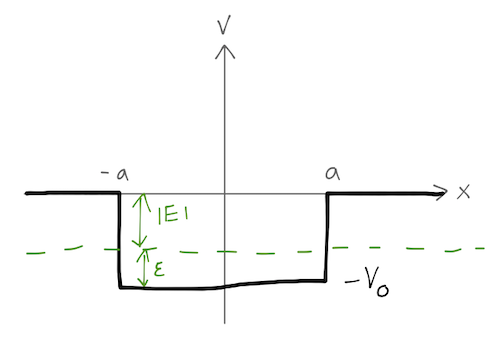
We’ll begin with the case where -V_0 < E < 0, looking for bound states. The wave number inside the well is the usual k = \sqrt{2m(V_0 - |E|)} / \hbar. The exponential decay constant outside the well is \kappa = \sqrt{2m|E|} / \hbar. The general solution looks like \psi(x) = \begin{cases} B_+ e^{+\kappa x}, & (x < -a); \\ A_+ e^{ikx} + A_- e^{-ikx}, & (-a < x < a); \\ B_- e^{-\kappa x}, & (x > a). \end{cases}
However, instead of solving this directly, we first notice that because the potential is symmetric in x, parity commutes with our Hamiltonian. Thus, we know that we can split the solutions into those with even parity, \psi_e(x) = \begin{cases} A \cos kx, & |x| < a; \\ B e^{-\kappa |x|}, & |x| > a. \end{cases}
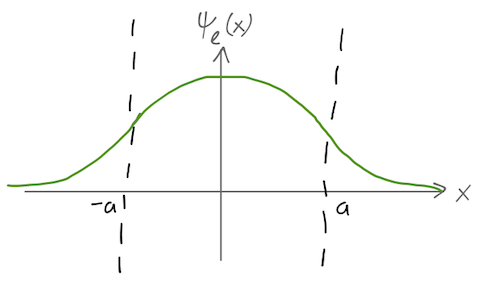
and those with odd parity, \psi_o(x) = \begin{cases} A' \sin kx, & |x| < a; \\ B' e^{-\kappa x}, & x > a; \\ -B' e^{\kappa x}, & x < -a. \end{cases}
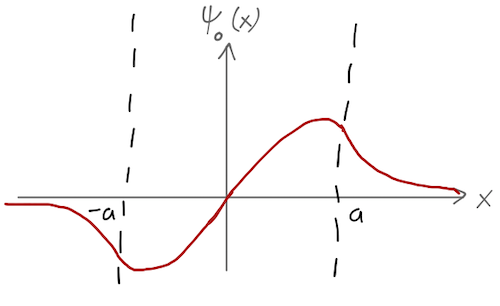
So we’ve immediately reduced our unknown coefficients from 4 down to 2 for each subset of solutions. We’ve also reduced the number of constraints from continuity to 2, since continuity of \psi(x) and its derivative at x = +a now also guarantees it at the reflected boundary x = -a. There is one more constraint, overall normalization of the wavefunction; only certain values of the energy E will allow us to satisfy all constraints, as expected for bound states.
Let’s start with the even-parity solution. Applying the boundary condition at x=a (the other boundary is redundant thanks to parity!) to this state gives A \cos ka = B e^{-\kappa a} \\ -Ak \sin ka = -B\kappa e^{-\kappa a} which can be combined to obtain a condition on the wave numbers and thus the allowed energy E: ka \tan ka = \kappa a. Similarly, for the odd-parity states we find ka \cot ka = -\kappa a. Now let’s define for convenience the parameters \xi \equiv ka and \eta \equiv \kappa a. From the definitions of k and \kappa, we see that \xi^2 + \eta^2 = \frac{2ma^2}{\hbar^2} (E + V_0 - E) = \frac{2ma^2}{\hbar^2} V_0, while from above we have (for even parity) \xi \tan \xi = \eta. This is a transcendental equation, so we can’t find a closed-form solution. However, we can solve this pair of equations graphically. If we plot \eta vs. \xi, then the first equation above defines a circle with radius \sqrt{2mV_0} a/\hbar; solutions occur wherever this circle intersects the function \xi \tan \xi.
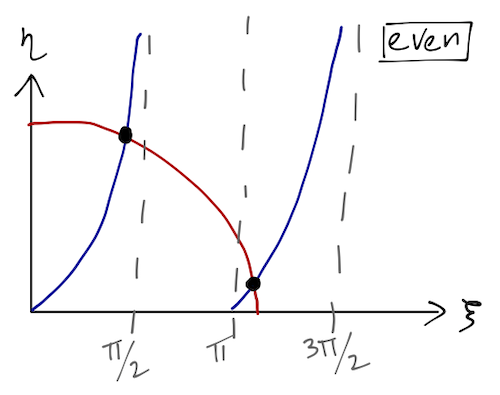
These are solutions for the bound-state energy E, which determines the values of k and \kappa. Notice that even as the radius of the circle vanishes, we will always find at least one even-parity bound state. As the radius rises (the well becomes deeper or wider), the number of solutions increases. If we take V_0 \rightarrow \infty then we find an infinite number of bound-state solutions, corresponding to the (even-parity) standard results for the infinite square well.
What about the odd-parity solutions? We have the same equation for the circular curves, but now the boundary conditions instead yield the relation \xi \cot \xi = -\eta.
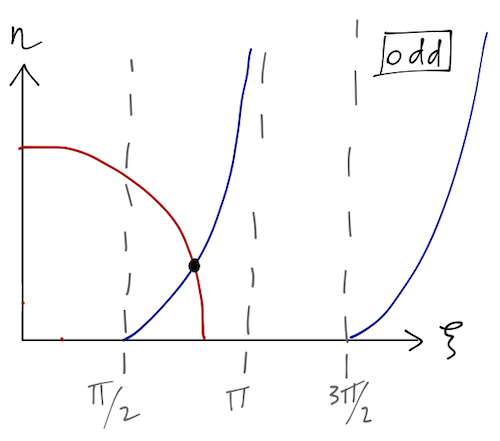
Now we see that there will be no solutions if \sqrt{2mV_0} a/\hbar < \pi/2; if the potential well is too shallow, there are no odd-parity bound states.
For completeness, I’ll note that we can also study scattering from the square well, i.e. solutions with E>0. We will find similar results to what we had for the barrier before: I won’t go through the details, but in particular we find for the transmission coefficient T = \left(1 + \frac{\sin^2(2k'a)}{4E/V_0(E/V_0+1)} \right)^{-1}. so we once again have resonance at precisely the values 2k'a = n\pi. (However, note that the definition of k' has changed: for the potential barrier we had k' = \sqrt{2m(E-V_0)}/\hbar, while for the well it is k' = \sqrt{2m(E+V_0)}/\hbar.)
We can think about this more physically to understand the source of the resonant behavior. Remember that at any barrier, a quantum-mechanical particle will undergo both transmission and reflection (this is possible because the wavefunction allows a single particle to be non-localized in a sensible way.) Although we’ve focused on the final transmission amplitude, there is generically transmission and reflection at both edges of the barrier. In particular, some part of the incident plane wave A will be reflected internally some number of times before finally being transmitted into outgoing wave F. The condition 2k'a = n\pi can be rewritten as 4a = n (2\pi/k'), in other words, transmission resonance occurs when the distance 4a traveled by an internally reflected wave is equal to an integer multiple of the de Broglie wavelength (2\pi/k'), resulting in constructive interference.
10.2.2 Selection rules from parity
In addition to looking at the Hamiltonian, parity can also provide very useful information about matrix elements of other operators. Suppose that we have any two parity eigenstates, \ket{\alpha} and \ket{\beta}: \hat{P} \ket{\alpha} = \pi_\alpha \ket{\alpha} \\ \hat{P} \ket{\beta} = \pi_\beta \ket{\beta} where as we know the eigenvalues are \pi_\alpha, \pi_\beta = \pm 1. We saw that certain operators have definite properties under parity transformation, in particular the position operator is odd, \hat{P} \hat{x} \hat{P}{}^{-1} = -\hat{x}. The matrix element of \hat{x} with respect to the two parity eigenstates is thus \bra{\beta} \hat{x} \ket{\alpha} = \bra{\beta} (\hat{P}^{-1} \hat{P}) \hat{x} (\hat{P}^{-1} \hat{P}) \ket{\alpha} \\ = \pi_\alpha \pi_\beta (-\bra{\beta} \hat{x} \ket{\alpha}). Therefore, if the two states have the same parity \pi_\alpha = \pi_\beta, then we find \bra{\beta} \hat{x} \ket{\alpha} = 0. This is a specific example of a selection rule. The name comes from application to systems such as transitions between atomic levels, where the atom will “select” only certain possible transition outcomes. In general, a selection rule is a statement that certain matrix elements must vanish based on symmetry considerations.
There are many applications of selection rules, but one common result of parity selection in particular has to do with dipole moments. Many transitions between atomic orbitals involve the electric dipole operator proportional to \hat{\vec{x}}, which is odd under parity. As a result, such transitions are forbidden between any two states that have the same parity eigenvalue. More generally, an arbitrary charge distribution will have an electric dipole moment (EDM) linearly proportional to \hat{\vec{x}}, and for a given atomic orbital \ket{\alpha} the EDM is given by the expectation value \bra{\alpha} \hat{\vec{x}} \ket{\alpha}. But for any parity eigenstate, odd or even, we can immediately see that \bra{\alpha} \hat{x} \ket{\alpha} = 0. Thus for any system in which the Hamiltonian is parity invariant, no (non-degenerate) energy eigenstate can possess a permanent EDM.
10.3 Symmetry and groups
While we’ve now seen some of the basic ideas of how symmetry operators are used in quantum mechanics, parity is an exceedingly simple example. To understand more interesting kinds of symmetries, we should take some time to develop a bit more of the mathematics behind symmetry.
We begin with the idea of a group. A group is a collection of some objects (a set), together with a product operation \cdot which satisfies the following rules:
- Closure: (a \cdot b) is still in the group
- Associativity: a \cdot (b \cdot c) = (a \cdot b) \cdot c
- Identity: the group contains 1 so that (1 \cdot a) = (a \cdot 1) = a
- Inverse: each a has another element a^{-1} satisfying a^{-1} \cdot a = a \cdot a^{-1} = 1.
These are, in fact, exactly the natural rules to describe a symmetry in physics. In a very high-level sense, a symmetry means that there are different “points of view” under which a physical system is the same - equivalent descriptions of the same object. (For example, we often think of parity as an active transformation - mirror reflection - but it’s just as good to take the passive picture and observe that parity symmetry means the system has the same coordinates when we turn our coordinate axes backwards.) In this more abstract point of view, there are some obvious properties that we need:
A. If we change our point of view twice, we should get another point of view of the same system; B. We should be able to switch freely between points of view, since they are equivalent descriptions; in particular, if we can change from POV A to B, we should also be able to change from B to A.
If you think about what these properties imply, it should be obvious that they map nicely onto the structure of a group: A tells us we want a set and a product operation with closure, and B tells us that we should have an inverse and therefore also an identity. (Associativity is sort of a technical property that comes along for the ride, without which our order of operations would get weird.) So, symmetries in physics are naturally described in terms of symmetry groups.
As an exercise in literal “points of view”, let’s consider the symmetry group of rotations by (multiples of) 90 degrees in two dimensions. Thinking of this as a coordinate transformation, we have four “points of view” - that is, four directions in which the positive x axis can be pointing.
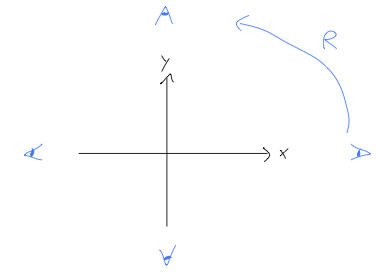
To reveal the group structure, let’s call R the group element corresponding to a single counter-clockwise rotation by 90 degrees.
Applying R \cdot R gives us a rotation by 180 degrees, another element of the group; instead of introducing another letter, we can just call this element R^2. Similarly, R^2 \cdot R = R^3 is a rotation by 270 degrees. Finally, R^3 \cdot R = 1; if we rotate by 360 degrees, we come back to where we started, i.e. the identity. We see evidently that the group is closed; moreover, every element of the group matches on to one of the four points of view we identified to start with.
We also need an inverse operation, which is simply provided by rotating clockwise: following the notation above, we could call this element R^{-1}, but you can easily convince yourself that R^{-1} is just R^3, the 270-degree counter-clockwise rotation. In fact, we have already written down all of the group elements - which is good, because we already have four of them, and if there was a fifth then there would have to be a fifth point of view that we have missed so far!
So, the discrete 2d rotation group is the set of elements \{1, R, R^2, R^3\}, with products defined as described above. If you have a strong math background, you may recognize this as the four-dimensional cyclic group, denoted \mathbb{Z}_4. In general, the cyclic groups \mathbb{Z}_n consist of a set of elements \{1, g, g^2, ..., g^{n-1}\}, with products defined in the obvious way that g^{j} g^{k} = g^{(j+k\ {\rm mod}\ n)}.
Thus far, this is just a transformation group; but, it will be a symmetry for any system that looks identical from all four points of view, such as a square.
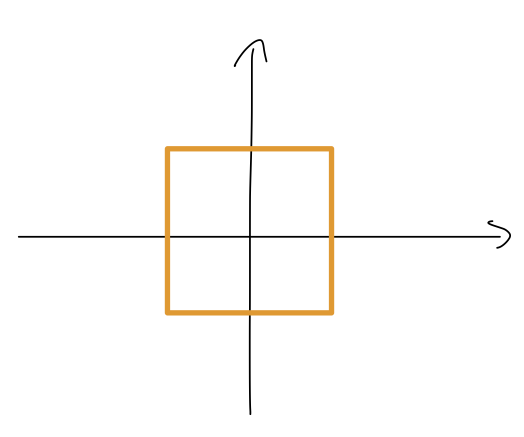
In fact, we could also describe this symmetry group as “the rotational symmetry group of a square”. (The full symmetry group of a square is the dihedral group D_4, which has 24 points of view that are generated by both rotations and reflections. But that would just complicate the math in this example without adding much else!)
10.3.1 Symmetry and representations
In physics especially, we’re not just interested in the structure of groups themselves; most of the groups we care about are symmetry groups, which means they also have an action associated with them, i.e. symmetry group elements act on physical objects and transform them in some way. In the example of discrete rotations above, group theory tells us how we can move our point of view of the system around, but to decide whether the system itself is invariant (looks the same), we need to know how the system itself responds to moving around the symmetry group.
A natural way to describe this aspect of symmetry in physics is with representation theory. Representation theory starts with a familiar but very big and flexible group called GL(N,\mathbb{C}), which is the group of N \times N invertible matrices with complex entries, under multiplication. (Actually, representation theory is more general than this - we could use real matrices, for example - but for quantum mechanics complex matrices are the most natural thing to use.) The idea is basically that matrices in GL(N,\mathbb{C}) are so flexible that if we are handed a group, we can completely mock up (or “represent”) the elements of the group and their products in terms of matrices with standard matrix multiplication.
Let’s be more concrete: a representation r is a map from a group G into matrices over a vector space V, r: G \rightarrow GL(V). Because this map is supposed to “represent” what the group does, it must “preserve the group product”: in other words, a \cdot b = c \Rightarrow r(a) r(b) = r(c) where the product between representations is defined by matrix multiplication. Now, this condition alone doesn’t give us the full structure of the group in our matrices: the simplest map we can always define is the trivial representation, r(g) = 1 for all g; this always satisfies the relationship r(a) r(b) = r(c), but it does so in sort of a simple way, by “collapsing” the whole group down to just the identity element. We can preserve the group structure through the map by insisting on a faithful representation, for which if a and b are distinct elements of the group G, we have r(a) \neq r(b).
Even with faithful representations, there can still be many ways to construct a representation r. Even for the simple cyclic group \mathbb{Z}_2, i.e. the group with two elements \{1, a\} and a^2 = 1, we can obtain a faithful representation of any dimension N just by mapping 1 into the N \times N identity matrix, and a into any N \times N matrix A = r(a) satisfying A^2 = 1 - of which there are an infinite number of possibilities! (The value N is said to be the dimension of the representation d_r.)
Having an infinite number of ways to map things seems bleak, but there are some very powerful results in representation theory that can simplify things. In particular, for a finite group G it can be proved that there are a finite number of unique “irreducible” representations, and any representation can be broken up into a combination of the irreducible ones. (In terms of our \mathbb{Z}_2 matrix example, most of the infinite set of matrices that square to 1 can be mapped into each other by a change of basis, and in the remaining classes we can identify subspaces of the matrices that repeat over and over.)
The mathematics of representation theory is beautiful and very deep, but we won’t go too far into it for this course, mostly just drawing on results as needed. (If you’re interested in a guided tour of more of the mathematics from a physics-friendly perspective, see this nice set of notes from a grad student at Harvard. ) But I want to elaborate on why representation theory is so useful for symmetries in physics: it gives us a really natural and powerful way to talk about how symmetry acts on physical objects! The basic idea is as follows:
- We write our symmetry down as a group.
- We classify every object in our system by its representation under the given symmetry group.
- Based on the two steps above, we know how everything transforms when we apply our symmetry, and we can identify whether things are invariant or not.
In step 2, specifying the representation includes the dimension d_R, which tells us that we have to describe our physical object as a vector of the same dimension. Symmetry operations are then matrices that act on these physical vectors. In quantum mechanics, this is obviously very natural: all of our quantum states are already complex vectors, and we already think of our symmetry operators \hat{U} as (unitary) matrices that act on our vectors.
You are, in fact, much more familiar with all of this than you might expect, although it probably wasn’t described in terms of groups and representations at first! A great example is rotational symmetry in classical mechanics. You already know that you can describe an arbitrary rotation in space in terms of 3x3 rotation matrices; these matrices form a group known as the “special orthogonal” group SO(3), which is the group of 3x3 matrices with \det R = 1 (special) and R^T R = 1 (orthogonal).
As you already know, rotation acts differently on different physical objects. Remembering back to classical mechanics, a position vector transforms differently from, say, the inertia tensor, which transforms differently from a scalar quantity like energy: \vec{r} \rightarrow R \vec{r} \\ I \rightarrow R^T I R \\ E \rightarrow E
Now that we know the mathematical language, it should be obvious that we can identify each of these quantities with a different representation of the rotation group! Specifically, energy lives in the trivial representation (doesn’t transform at all!), \vec{r} lives in a 3-dimensional representation (which turns out to be the d_r = 3 representation for SO(3),) and the inertia tensor I lives in a 9-dimensional representation. We’re still using 3x3 matrices to transform the inertia tensor, but this is just notation - I is a nine-component object, and we could rewrite it as a length-9 vector with a corresponding 9x9 rotation matrix.
One note on terminology: the representation itself concerns how the matrices R(g) are constructed and how they interact with each other. For a physical object - the vector that the matrix acts on - there isn’t a separate term - I’ll say things like “lives in the representation” or “transforms under the representation”. (As far as I know, there is no standard term in the math literature for the vectors themselves; mathematicians doing representation theory just care about the matrices. We care very much about the vectors since they are the physical objects in our system!)
Here, you should complete Tutorial 5 on “Symmetry groups and representations”. (Tutorials are not included with these lecture notes; if you’re in the class, you will find them on Canvas.)
Our main application of parity above was in the context of wave mechanics, which uses the infinite-dimensional Hilbert space spanned by \ket{x}. Parity acts to map us to the state on the opposite side of the origin, \hat{P} \ket{x} = \ket{-x}. With infinite dimensions we can’t really use matrices for our operators, but we can sort of think of this schematically as a matrix: if we consider the states near the origin, say \{...\ket{-2\epsilon}, \ket{-\epsilon}, \ket{0}, \ket{\epsilon}, \ket{2\epsilon}, ...\}, then the matrix elements locally look like this: \hat{P} = \left(\begin{array}{ccccc} 0 & 0 & 0 & 0 & 1 \\ 0 & 0 & 0 & 1 & 0 \\ 0 & 0 & 1 & 0 & 0 \\ 0 & 1 & 0 & 0 & 0 \\ 1 & 0 & 0 & 0 & 0 \end{array}\right) with the matrix extending infinitely in both directions. This is an infinite-dimensional representation for the parity symmetry group, \mathbb{Z}_2; even though the matrix is infinite, it should be intuitive that squaring it will give the identity.
Let’s consider some other representations of the same symmetry. Consider an H_2 molecule:
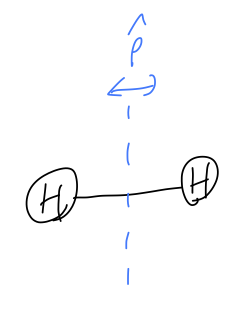
Label the two atoms as A and B, and the respective quantum states as \ket{A} and \ket{B} (which could represent, say, which atom an electron is localized around.) Then parity about the center of the molecule swaps \ket{A} with \ket{B}, so it is represented by the two-dimensional matrix \hat{P} = \left( \begin{array}{cc} 0 & 1 \\ 1 & 0 \end{array}\right) which again is easily verified as a giving a representation of \mathbb{Z}_2. You can see the pattern here and write similar results for any number of dimensions in-between. Of course, part of the reason this is so simple is because the group \mathbb{Z}_2 is so tiny. More complicated groups will have more interesting and varied representations as we change the number of dimensions.
One more little fact about representations of \mathbb{Z}_2, i.e. parity. We know that given a quantum operator, we can (usually) compute its eigenvalues and eigenkets, and then it’s possible to change to a basis in which this is diagonal. We can certainly do this for the H2 example above; the matrix is just the Pauli matrix \hat{\sigma}_x, and its eigenvalues are \pm 1. So after a basis change, we can rewrite it as \hat{P} \rightarrow \left( \begin{array}{cc} 1 & 0 \\ 0 & -1 \end{array} \right) and the eigenvectors are \ket{+} = (1, 1), the parity-even superposition of the two atoms, and \ket{-} = (1, -1), the parity-odd superposition. In fact, this is a very general fact about representations over the complex numbers for \mathbb{Z}_2: there are only two irreducible representations (“irreps”), the “trivial” representation and the “sign” representation, both of which are one-dimensional: T:\ r(1) = 1, r(p) = 1; \\ S:\ r(1) = 1, r(p) = -1. If we start with a \hat{P} operator in N dimensions, it can always be diagonalized and reduced to a set of vectors which transform either according to the trivial irrep T (physically, these are “even states” under parity), or the sign irrep S (“odd states”).